
DMX Officially Traded on the Stock Exchange, Unveiling a New Era of Growth
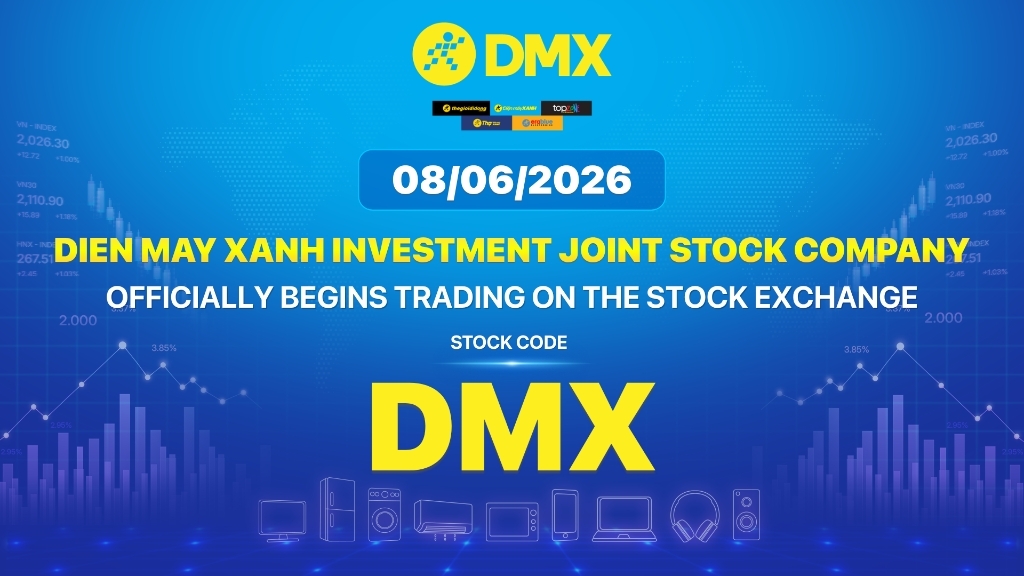
Ho Chi Minh City, August 6, 2026 – Dien May Xanh Investment Joint Stock Company (DMX) today officially listed its shares on the Ho Chi Minh City Stock Exchange (HoSE), marking a significant milestone in its development journey after more than 20 years of continuous innovation and customer service.
The listing follows the completion of DMX's IPO – the most prominent "billion-dollar transaction" in the market over the past 5 years – with 166,438,500 shares successfully distributed, raising VND 13,315 billion (approximately USD 500 million). Nearly 90% of the distributed shares were allocated to nearly 60 investment funds, including 73% from foreign funds and 17% from domestic funds. Following the issuance, DMX's market capitalization reached VND 101,418 billion (approximately USD 3.9 billion), establishing a solid financial foundation for the Company to continue investing in long-term growth.
Officially becoming a public company and listing its shares is not only a financial milestone but also demonstrates DMX's commitment to enhancing governance capabilities, information transparency, sustainable development, and maximizing long-term value for shareholders, customers, partners, and employees.
Starting as a retail enterprise for technology and consumer electronics products, DMX now owns a retail ecosystem featuring thegioididong.com, Dien May Xanh, TopZone, Dien May Xanh Services JSC (DMX Technicians), and EraBlue in Indonesia, serving tens of millions of customers annually through a network of over 3,000 stores alongside a nationwide omnichannel sales platform.
Throughout its journey, DMX has consistently adhered to its customer-centric philosophy. The enterprise continuously invests in service quality, shopping experience, digital transformation, and technology applications to bring tangible values to consumers.
Speaking at the event, Mr. Doan Van Hieu Em, CEO of Dien May Xanh Investment Joint Stock Company, stated: "The first trading day on the stock exchange is a proud milestone, but it also brings greater responsibilities for the enterprise. As the second-generation (F2) leadership of Mobile World Investment Corporation (MWG), we inherit the immense achievements of the founders and hold the responsibility to lead this enterprise to new heights of success. We commit to continuous development built on transparency, effective governance, relentless innovation, and keeping customers at the center of every decision. The companionship of our customers, staff, partners, shareholders, media, Regulatory Authorities, and local Administrations will serve as the foundation for DMX to thrive sustainably in the future."
Listing shares enables DMX to expand access to capital markets, elevate governance standards to international practices, and generate additional resources to further invest in technology, logistics, retail ecosystem expansion, and domestic as well as international operations.
In the coming period, DMX is strategic oriented to develop based on 5 core pillars:
First Pillar: Quality-Driven Growth
Unlike the aggressive expansion phase, DMX now focuses on optimizing the operational efficiency of its existing store network. DMX shifts from opening stores to boost revenue to optimizing each store location to maximize profit; instead of sales being the end of a transaction, sales are now the beginning of the customer lifetime. This serves as the foundation of the entire architecture.
The effectiveness of the quality-driven growth strategy is clearly reflected in the business results. Cumulative for the first 6 months of 2026, net revenue reached VND 65,280 billion, up 27%; net profit after tax reached VND 4,876 billion, up 73% year-on-year. Net profit margin reached 7.5%, while gross profit margin expanded to 20.1%. These results correspond to completing 53% of the revenue plan and 66% of the full-year profit target for 2026.
Notably, Same-Store Sales Growth (SSSG) increased by 32%, while the store network remained streamlined at 3,013 stores, demonstrating that all growth stemmed from enhancing store productivity rather than expanding store count.
Second Pillar: Consumer Financial Services Ecosystem
In the old model, the customer journey typically began when a customer had already decided to "buy a TV" or "buy an air conditioner." In the new model, transactions start from the moment customers begin considering their finances.
Information from DMX indicates that up to 74% of consumers consider installment purchases or consumer finance solutions when buying high-value consumer electronics. DMX does not leave customers to navigate cost challenges alone; instead, it integrates deferred payment options directly at point-of-sale. When cash barriers are removed upfront, many customers upgrade to higher product segments. Through this strategy, DMX can elevate the Customer Lifetime Value (CLV) of each client.
According to H1/2026 business results, DMX recorded 38% of revenue coming from deferred payment methods, with installment revenue growing by 49% year-on-year. Currently, 96% of the product portfolio is eligible for financial programs.
Concurrently, over 3,000 Dien May Xanh and Mobile World stores have transformed into "financial service hubs" – where customers can deposit, withdraw, transfer money, pay utility bills (electricity, water, internet), buy insurance, etc. This drives frequent store visits without requiring customers to purchase major appliances each time. In the first 6 months of 2026, the system served 36 million transactions, totaling VND 56,000 billion in transaction value, further expanding non-traditional retail revenue sources.
Third Pillar: Tho Dien May Xanh (DMX Technicians)
In many retail chains, delivery, installation, and warranty services are still viewed as unavoidable "mandatory expenses." DMX takes the opposite approach: transforming the after-sales segment into a professional subsidiary – Dien May Xanh Services JSC Dien May Xanh Technicians) – and operating it as an independent profit center.
In 2025, Dien May Xanh Technicians recorded revenue of VND 2,576 billion and net profit after tax of VND 201 billion. Cumulative for the first 6 months of 2026, this segment achieved VND 1,892 billion in revenue, up 47% year-on-year; of which VND 195 billion came from external customers, raising the external revenue proportion to 10.3%.
This demonstrates that after-sales service is no longer a lost cost within gross margin, but an independent, profitable revenue source. With a large team of technicians, DMX possesses a service ecosystem robust enough to serve external clients, opening up B2B opportunities: installation and maintenance for other retail partners, real estate projects, and infrastructure contractors. Furthermore, the presence of DMX Technicians in customers' homes serves as a golden touchpoint for brand recall and upselling opportunities. Consequently, a single purchase of a TV, air conditioner, or washing machine can trigger multiple subsequent service revenues.
Fourth Pillar: Super App and Omni-channel
The Super App is defined not merely as a platform for promotional deals, but as the central hub for managing end-to-end customer relationships: from storing purchase history, maintenance schedules, and personalized reward points to facilitating bill payments and direct booking for DMX Technicians.
In Q2/2026, the Super App reached 19 million members (an increase of 1 million from the beginning of the year); online revenue reached VND 7,330 billion, contributing 11% to total revenue. The digital ecosystem continues to be enriched with over 4,000 co-branded cards successfully opened on the Super App, and the AI assistant "Super Star" achieving an 86% satisfaction rate after Phase 1 (information consulting); approximately 2 million customers received tailored offers on the platform.
Fifth Pillar: EraBlue – The Second Dien May Xanh in Indonesia
EraBlue serves as field proof that the Dien May Xanh business model can be successfully replicated beyond Vietnam's borders. Indonesia boasts a population three times that of Vietnam and a mobile phone market 1.5 times larger, yet its after-sales service remains largely unorganized – precisely the gap the Dien May Xanh model was engineered to fill.
After more than 3 years since establishment, EraBlue has become the No. 1 consumer electronics retail chain in Indonesia. By the end of June 2026, the chain reached 261 stores, an increase of 146 stores year-on-year and 80 stores compared to the start of the year. Despite average selling prices being only 70% of those in Vietnam, revenue per store is 1.5 to 2.6 times higher than domestic Dien May Xanh stores of equivalent size.
Cumulative for the first 6 months of 2026, EraBlue recorded IDR 1,888 billion in revenue, up 92%, with Same-Store Sales Growth (SSSG) up 17%, net profit after tax surging 154%, and officially erasing all accumulated losses. With 100% of new stores reaching break-even within 6 months, EraBlue aims to expand to 300–350 stores by the end of 2026 and 1,000 stores by 2030, opening up future IPO potential.
DMX’s strategic orientation in this new phase continues to place customers at the core. Building upon this foundation, the Company will progressively expand growth opportunities across 5 core pillars spanning the entire product lifecycle – from shopping needs and usage to upgrades, after-sales services, and value-added offerings. Each pillar is constructed to complement one another, creating a seamless ecosystem that enhances customer experience and drives sustainable operational efficiency over the long term.
Immediately following the listing, DMX will pay a cash dividend of VND 4,000 per share from cumulative retained earnings through the end of 2025. The record date for shareholder entitlement is August 19, 2026, with the payment date scheduled for August 26, 2026. Expected in December 2026, DMX will further advance an interim cash dividend of VND 2,000 per share for 2026.
By April 2027, following the Annual General Meeting of Shareholders (AGM), DMX plans to pay an additional VND 2,000 per share, fulfilling its commitment to a minimum cash dividend payout ratio of 50% of 2026 net profit after tax. Concurrently, DMX will consider distributing remaining profits via stock dividends combined with share premium from the IPO, with an expected ratio of 1:1.
Thus, total projected benefits within 12 months post-listing include VND 8,000 per share in cash dividends (equivalent to a 10% yield on the IPO price of VND 80,000 per share) and a stock dividend at a projected 1:1 ratio.
This initial trading milestone ushers in a new development phase under the leadership of a young management team, driven by an innovative mindset, pioneering spirit, and the ambition to propel DMX into a new growth cycle. Built upon a foundation cultivated over more than two decades, combined with a clear strategic roadmap and relentless capacity for innovation, DMX strives to become a leading retail and consumer services group in the region, delivering sustainable value for all stakeholders.