
INVESTOR RELATIONS
 Tiếng Việt
Tiếng Việt
Tiếng Việt
Posted date: 28/06/2018
We understand that when MWG announces Bach Hoa Xanh (“BHX”) as the main pillar of MWG’s growth from 2020 onwards, BHX will attract a lot of public attention on the chain’s operational and financial performance. MWG started piloting the “modern wet market” BHX concept in late 2015 with the key differences from the convenience stores in terms of target customers, product range and price strategy.BHX is a minimart/food-store chain with the size of 150-300 sqm per store, specializing on fresh foods and daily basic needs. These stores are located in the secondary streets on the way when people go back home and in residential areas. Each store has 2000-3000 SKUs, of which, the fresh category contributes for approx. 1/3 of sales value. BHX is aimed to offer wide range of fresh, high-quality and traceable-origin products, at very competitive price compared to the traditional wet market and mom-and-pop grocery stores. All BHX stores with hygiene space will be located in accessible locations. With these unique features, BHX model is unlike other convenience stores in Vietnam that offer “ready-to-eat” products and packaged foods, comfortable seating areas to the young and white-collar workers who are willing to pay premium for these services. From 47 stores by end of 2016, BHX has expanded aggressively (1 new store in 1.5 days) to become the largest mini-mart/ food-store chain in Vietnam with 283 stores by end of 2017. According to AC Nielsen, BHX has surpassed other well-established minimart/food-store chains in Vietnam by store count (Quarter by Numbers – Asia Pacific 4Q17). In terms of revenue, BHX was in Top 2 mini-mart/ food-store chain in 2017, according to Euromonitor’s report and MWG’s own estimation (Retailing in Vietnam, 2017).After making the strategic change in slowing down the store expansion and focusing on the store sales, we have recorded positive growth in the average monthly revenue per store of over VND800 million (~US$36,000) in May 2018 (calculated for all stores that have at least 30 full days of operation). We decided that the ideal new outlets should be located in the secondary streets (not the commercial streets) in order to drive good customer traffic and generate sufficient revenue for aiming at break-even point at the stores. Consequently, we delay the earlier plan of thousand stores penetrating deeply into residential areas and adjust the expansion target up to 500 stores in HCMC by end of 2018. Thanks to this timely decision, 100% of the newly-opened stores since April 2018 recorded approx. VND1 billion (~US$45,000) average monthly revenue per store. We also push for converting the stores that have not yet reached their full potential in generating sales into “Fresh meat, fresh fish” model with the wider range of over 150 fresh SKUs. As a result, these stores have recorded approx. 20% higher traffic and revenue than the normal ones. In term of operational efficiency, our statistics show that BHX chain served around 4.5 million transactions in May 2018, equivalent to 1 successful transaction per 2 minutes (assuming full capacity in operating hours from 6:30am to 9:30pm). 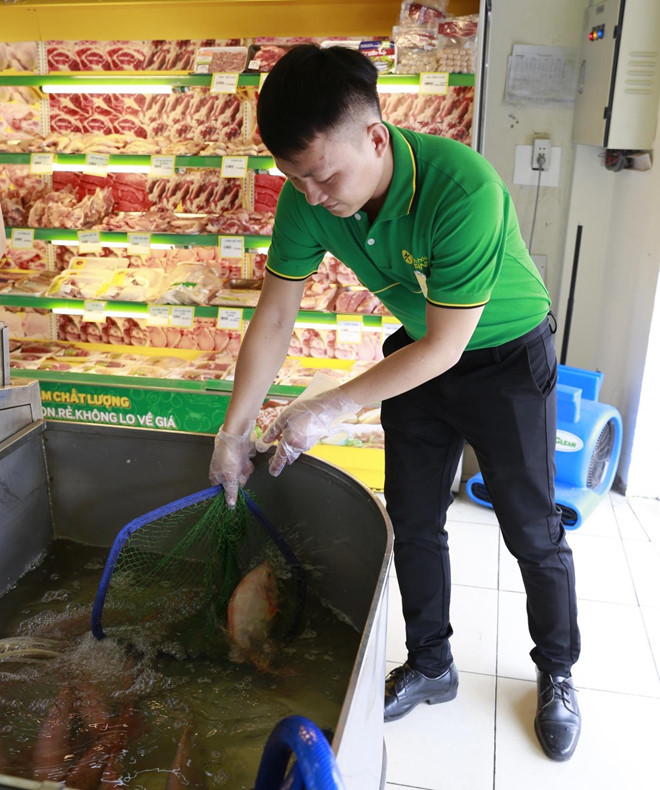
New "Fresh fish" model at BHX stores
In term of profitability, the gross profit margin (“GPM”) has increased from 12% in 2017 and 14% in 1Q18 to nearly 16% in May 2018 (after deducting the wastage and losses). This GPM improvement is on-track to reach 18% in the next 6 months for EBITDA break-even at store level. The improvement of GPM mainly comes from lower COGS because of better bargaining power for large order and the trust of manufacturers and suppliers on BHX brand. Although the chain recorded loss at store-level, the loss is still insignificant compared to almost other grocery retail chains in Vietnam. BHX is continuing the effort to refine its controlling system and optimize tools for more effective operation management.When penetrating into new business, most retailers would suffer significant losses in years to scale up their chains as fast as possible for gaining market shares. At MWG, we decides to expand BHX chain only after we fine-tune the winning formula and the existing stores reach EBITDA break-even point at store level. With this cautious approach, we aim to (1) ensure the benefits of MWG’s long-term investors well-protected and (2) develop a new growth driver for MWG in the most sustainable way. Referring to the regional case study of Alfamart, this minimart/food-store chain is currently accounting for approx. 40% market share in Indonesia. It took Alfamart 5 years since its inception in Oct 1999 to turn the business into profitable stage with the first announced net profit after tax in 2005 of several hundred thousand dollars. In that year, Alfamart revenue was US$280 mil and GPM was approx. 15% with more than 1,200 stores. In 2017, Alfamart achieved US$4.5 billion revenue and maintain approx. 20% GPM with more than 10,000 stores nationwide. Despite its proven business model and years of successful operation experience in Indonesia market, when Alfamart entered into Philippine in 2014, the group expected to be break-even in the middle of 2017 (Alfamart annual reports and official news release).In BHX, we build our trust by actively listening to customers’ feedbacks, acknowledging the mistakes and quickly making adjustments with the aim of offering excellent shopping experiences to our customers. We strongly believe in the success of BHX in Vietnam’s huge potential grocery retail market with the estimated size of US$65 billion and 90% of the market share belongs to traditional wet market and mom-and-pop stores.Category: Internal analysis